2021年2月21日星期日

接种疫苗推高需求 全球缺124亿只手套


Nanyang Tue, Feb 16, 2021 07:20pm - 4 days ago


(吉隆坡16日讯)冠病疫苗接种进展愈发乐观,分析员相信从中期来看,各国接种疫苗期间将推高橡胶手套需求,并预计今年全球手套供应短缺将达到124亿只,进而扶持平均售价。

丰隆投行研究分析员指出,在可预见的未来内,疫苗的推出和冠病检测频率升高,有助于提振手套需求及平均售价。

分析员同时表示,在今年的剩余时间里,接种疫苗带动的手套需求量增幅,将抵消冠病检测频率下滑造成的需求萎缩。

“由于全球疫苗推广才刚刚成形,我们预计手套平均售价暂时会保持在较高水平,即每1000只115至140美元。”

分析员也认为,最早也得在今年末季,才会看见手套平均售价下滑。

随着现有手套商积极提高产能,及有新业者进军分一杯羹,今年手套供应量预计扩大20%。

但分析员估计,今年内手套供应短缺仍会达到124亿只。

另一方面,分析员也举出两大理由,力证手套需求不会在短期内陷入萎缩。

第1个理由,是各国疫苗运输系统仍存在各种问题,分析员指出,这源于部分国家医疗资源捉襟见肘,及疫苗储藏方式众说纷纭。

“尽管美国已分发6000万剂疫苗,但截至今年2月8日,只有4240万剂被接种。”

“另外,虽然美国计划在首季让全民接种疫苗,但物流问题会拖累整个过程。”

此外,分析员也引用美国知名公共卫生专家福奇的说法指,需有70%至85%人接种疫苗,才能达到群体免疫效果。

“假设没有重大物流问题,美国预计在今年末季,才能达到群体免疫,明年首季则实现全民接种。”

牛转新机 | 电讯牛股不容忽视


Author:    |    Publish date: 


政府在2021年优先推行国家数码基建计划(JENDELA),预料将为特定电讯股注入很强的牛气,造就牛年的电讯业牛股,特别是马电讯(TM,4863,主板电讯媒体组)及时光网(TIMECOM,5031,主板电讯媒体组)崛起为首选,值得关注它们将溢出的财富。

分析员指出,政府致力在全国改善及加强数码联系及宽频的基建设施,马电讯及时光网将是最大赢家,它们将通过在国内固定宽频市场的渗透率,进一步提高国内市场占有率。

分析员指出,国内移动电讯将升级至4G,并关闭3G以及拓宽4G网络到97%的人口覆盖率,现有2G/3G站点将升级,预料新的4G站点将在2021-2022年建成。

这些新的4G站点将位于偏远和农村地区,并将由USP基金全额资助。现有4G站点的回传将升级到光纤(或至少一级跳到使用微波传输光纤),以增加平均值速度,从25Mbps提升至35Mbps。

3G网络将在2021年杪关闭,营运商可以重新部署4G的2100MHz频谱,从而推动更快速度,更大的网络容量,更有效地利用频谱。

手套股仍然获得强劲需求推动,预计销量将受需求驱动,使手套公司的盈利赚幅保持稳定,因为它们偏高的工厂利用率将有助转化为规模经济优势。

这使安联星展研究依然看好顶级手套(TOPGLOV,7113,主板医疗保健组)、贺特佳(HARTA,5168,主板医疗保健组)及高产柅品(KOSSAN,7153,主板医疗保健组)为牛年首要时势牛股。给它们的12个月合理目标价,分别为10令吉40仙、20令吉80仙及11令吉20仙,这使它们尚具吸引力,因比市价拥有相当高的潜在溢价。

谈到手套股的业务前景,安联星展研究指出,全球手套市场需求是由销量增长所推动。

预计冠病疫情和产能扩张将继续支持及应付市场对手套的需求。

分析员预计手套业2019-2021年的3年复合年增长率高达24%。一些国家和地区已经开始接种冠病疫苗,效果拭目以待。从疫苗的制造、分销和管理来看,要达到整体免疫所需剂量尚需花费一段时日。

美国的疫苗制造药剂公司──辉瑞公司及其德国合作伙伴BioNTech生产的疫苗,需要摄氏零下70度的存储温度,这可能会给后勤物流带来挑战。

因此,该行认为2021牛年的手套需求仍强劲。最重要的是,疫苗的推出还将支持手套需求,因为疫苗管理也需要使用手套。

手套原料的供应日益紧张,可能会限制丁腈手套的新入行的产能。手套业的主要业者顶级手套、贺特佳及高产柅品应该能够确保原料足够,特别是考虑到他们的规模,以及供应商与他们的长期良好关系,使它们拥有足够的原料供应。

预计手套原料价格将走高,主要是供应趋紧,直到2021年底的需求将持续增长,惟产品平均售价有增无减也带来盈利赚幅,足以抵销原料涨价。

该行认为,劳力短缺和更严格的劳动要求,也将增加新业者的挑战。预测大马手套生产商的手套销量,将在2021-2022财政年分别增加24%及8%。这使财测还有进一步上升空间,特别是持续出现需求与供应不平衡。

总结

预料马股有望在2021金牛年上演疫后回弹戏码,各行业将如“八仙过海”各显神通,若选股得当,将在这个牛年捉住牛角向上冲,赚得盘满钵满笑呵呵。!(下篇)

Fret not for Malaysia’s GLOVEs ‘still has legs to run’


HighlightsJoin the community of active traders. Membership is FREE. Already a member? Sign in.

gloveharicut

Author: gloveharicut    |   Latest post: Sun, 21 Feb 2021, 8:46 AM


Author:    |    Publish date: 


{{{PM me to join GLOVE Private Discussion Room}}}

I invite you to read my blog and make a smart GLOVE decision.

https://klse.i3investor.com/blogs/gloveharicut/blidx.jsp


I am reproducing the Focus Malaysia Article to my blog.

This post don't have any value added content.

Compile here for my own record.

Please skip if you don't like it.


https://focusmalaysia.my/markets/fret-not-for-malaysias-rubber-glove-sector-still-has-legs-to-run/

Fret not for Malaysia’s rubber glove sector ‘still has legs to run’


SENTIMENT towards the glove sector has doubtlessly changed – as evident on the stock price regression of the Big Four glove counters – given the rapid development on the COVID-19 vaccine scene.

Some investors have increasingly shifted their focus to recovery beneficiaries which has led share price correction of glove stocks across the board on Bursa Malaysia.

On the other hand, most glove companies expect 2021 to be a stronger year for them due to higher volume as a result of their production expansion coupled with higher average selling prices (ASPs) compared to 2020.

Some players expect sequential quarter ASP growth to continue into 3Q CY2020. While this is possible, MIDF Research opined that the rise will be at a smaller quantum due to the high-base effect.

“ASPs have more than doubled in 2020 compared to 2019,” the research house pointed out in a thematic report that focuses on the glove sector.

“We do not discount the possibility of softening blended ASPs in the second half when urgent sales start to soften.”

This is more likely to impact the spot price segment which is usually quoted at a higher selling price compared with contract orders. That said, the research house does not expect ASPs to decline sharply because demand may continue to exceed supply.

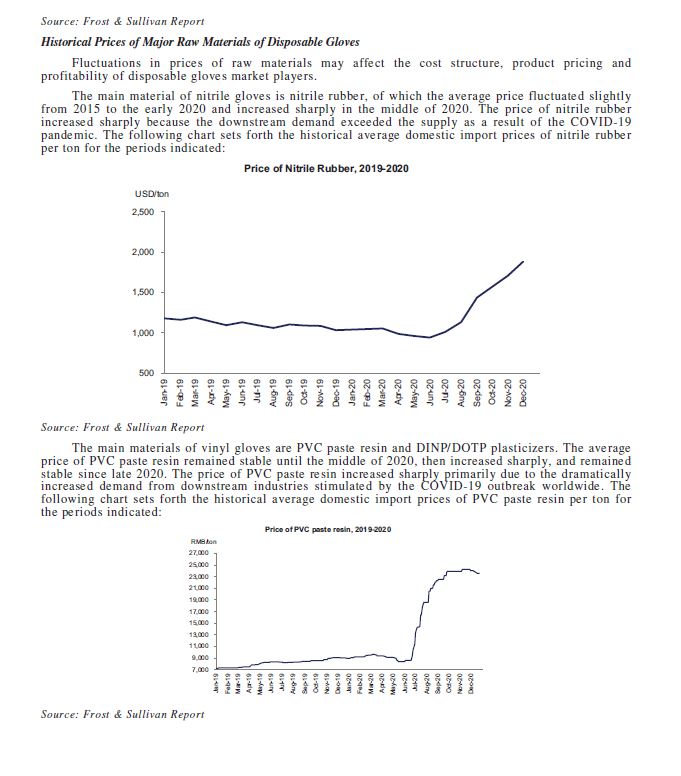
“With industry players projecting shortage in nitrile gloves that could possibly last until 2023 due to the shortage in raw material supply, ASPs for rubber gloves are expected to remain robust in the next 18 to 24 months,” projected MIDF Research.

“We view that high raw material prices will lend support to ASP of nitrile gloves.”

While industry players are expanding at a faster pace to keep up with demand, the research house reckoned that this is not done without challenges.

Other than the shortage in nitrile rubber, the industry is also facing labour shortage due to the closure of international borders.

The established glove players expect to further automate their processes in order to reduce number of workers per million pieces.

“The four companies under our coverage expanded by an estimated 21% in CY2020 compared to the preceding year when demand growth was estimated at 25%,” observed MIDF Research.

“Production challenges are among the main reasons why industry players foresee that demand will exceed supply in the near future.”

Going forward, the research house acknowledged that companies under its coverage are looking to further improve their products and manufacturing processes through research & development (R&D) as well as sharpening their business strategies.

All-in-all, MIDF Research maintained its positive view on the sector as it believes that demand growth will continue after the COVID-19 pandemic.

“Malaysia supplies about 65% of the world’s total rubber gloves which means collectively, Malaysian glove companies have market leader advantages,” justified the research house.

“The mature ecosystem in the country which has been built over a period of more than three decades, is expected to allow the established players to continue to remain efficient and competitive in the long term.”

On this note, MIDF Research maintained its “buy” recommendations on all the Big Four glove makers – Hartalega Holdings Bhd (target price: RM18.25), Top Glove Corp Bhd (TP: RM8.29), Kossan Rubber Industries Bhd (TP: RM7.33) and Supermax Corp Bhd (TP: RM13.83). – Feb 19, 2021


Glove is Bitcoin #Glovestronk!!


Author:    |    Publish date: 


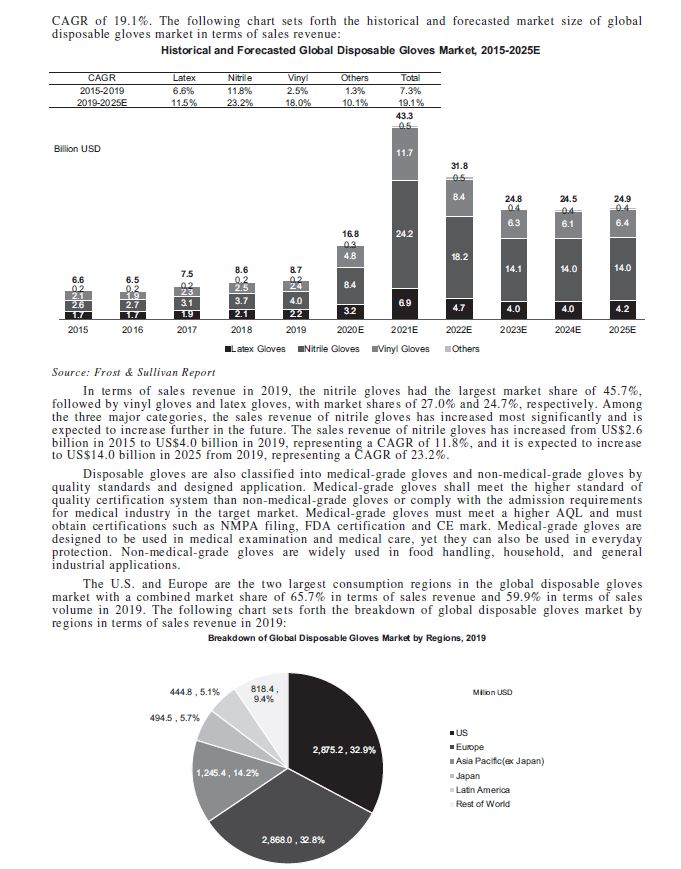
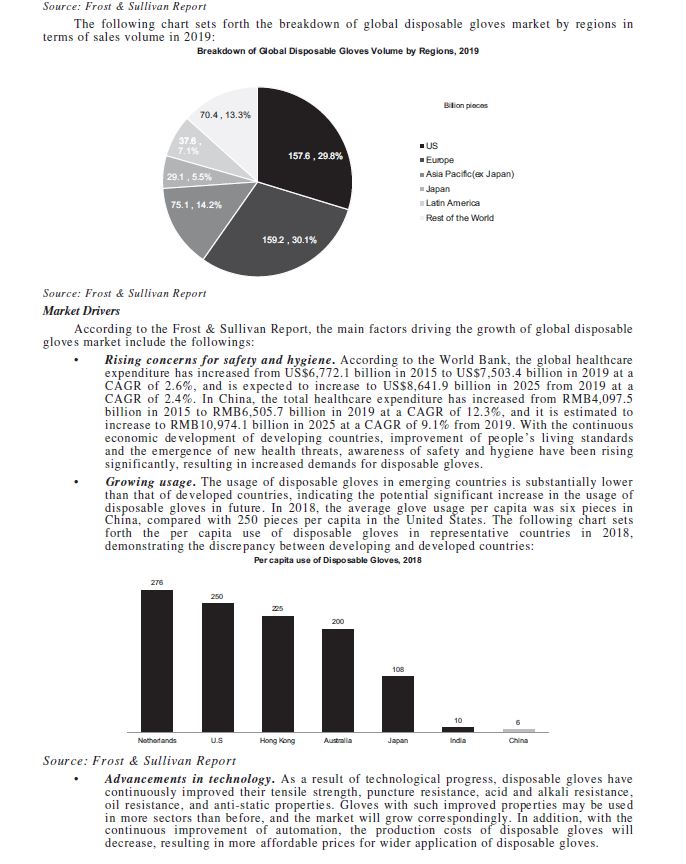
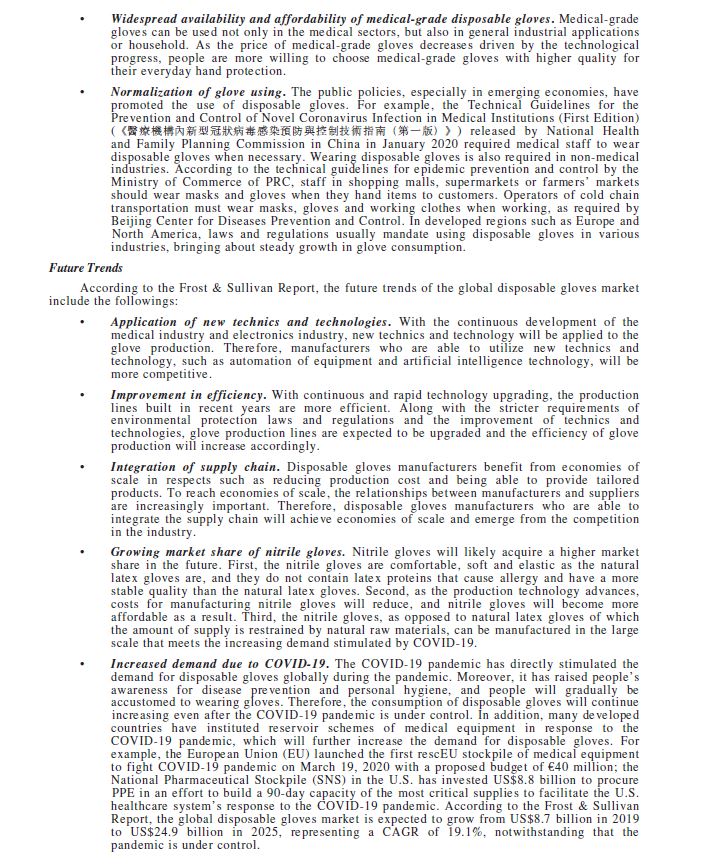
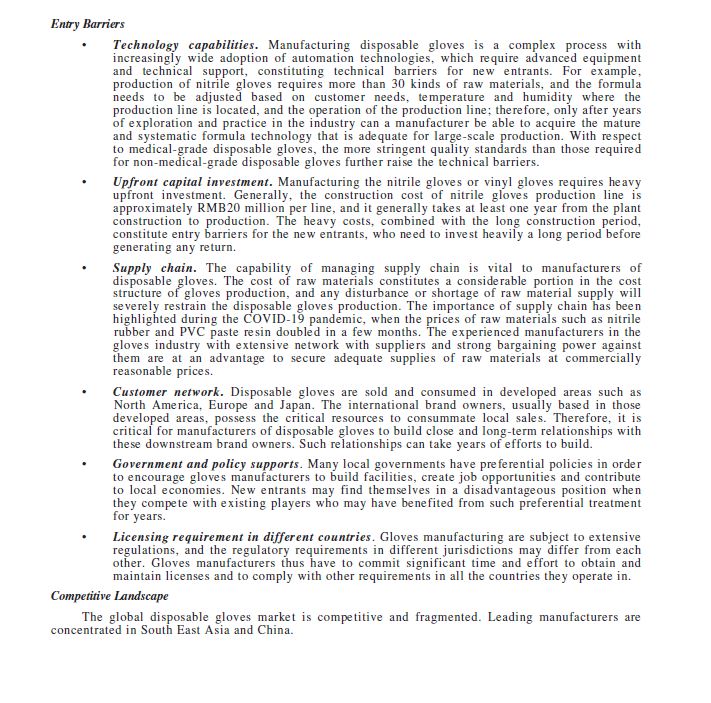
Happy weekend everyone. I would like to share with you a report on disposable glove industry overview.

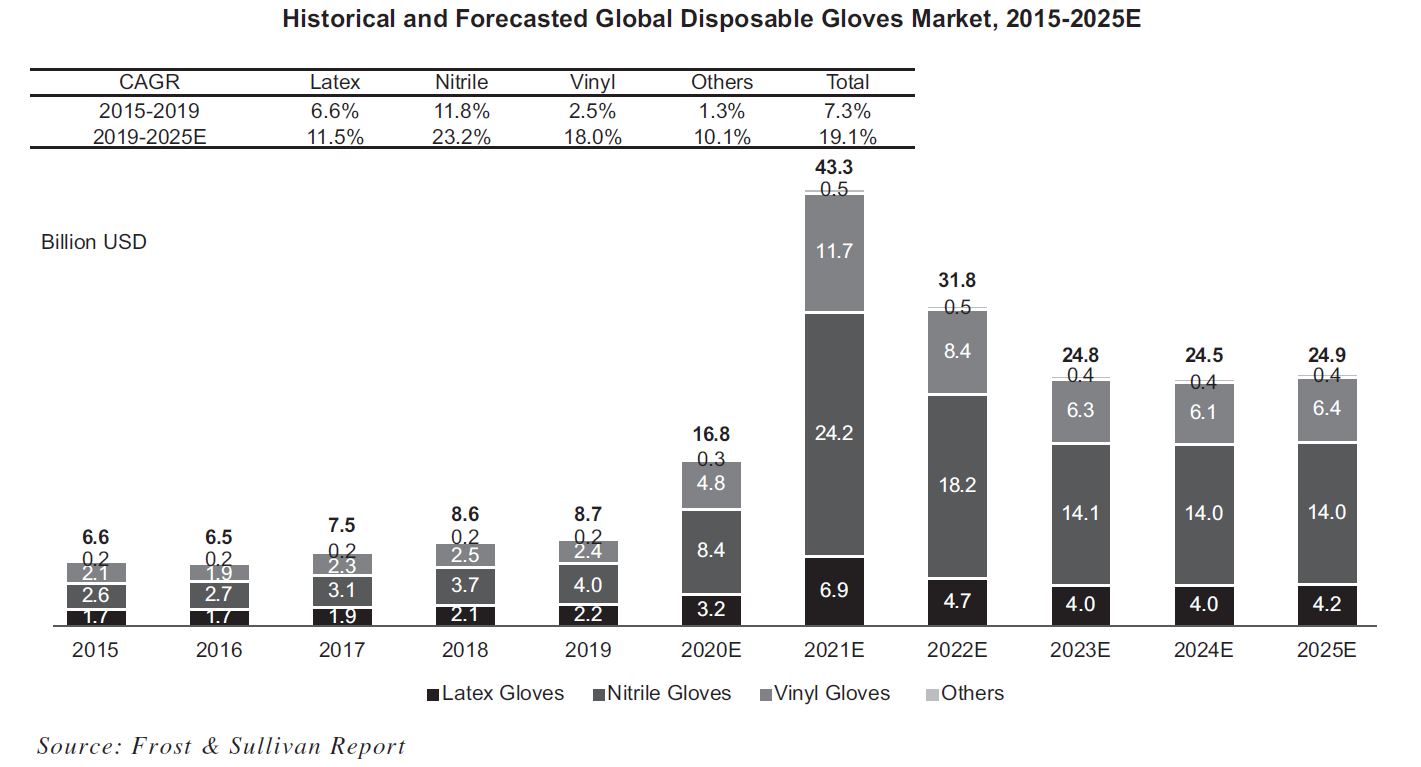
All in all, in terms of sales revenue, the global disposable glove market increased steadily from US$6.6billion in 2015 to US$8.7 billion in 2019, representing a CAGR of 7.3%. The global disposable gloves market is expected to grow from US$8.7 billion in 2019 to US$24.9 billion in 2025, representing a CAGR of 19.1%. JP Morgan stupid or what? Called sell on such a high growth sector among those in Bursa.

Nevertheless, Frost & Sullivan might overblow as well, so make your own judgement. Anyhow, happy reading everyone.

#GloveisBitcoin #Glovestronk!! #TopGlove #Hartalega #Supermax #Kossan


Dry Bulk Market is Bound for a Sustainable Rebound


The dry bulk market’s fundamentals are edging towards an improvement, in favor of ship owners. In its latest weekly report, shipbroker Intermodal said that “while 2020 is finally behind us, its negative impacts are still hovering over the shipping market. That being said, it is still too early to even speculate that 2021 will be a better year, even if the bar is set too low given to “what went down” last year”.

According to Intermodal’s SnP broker, Mr. Timos Papadimitriou, “the reality is that positive signs especially for the dry bulk market were seen as early as last summer when the market was slowly showing signs of better days to come. It took some time for shipowners to assimilate the possibility that we are heading towards better days – and nobody can blame them for being sceptical – but the increase on second hand transactions is the most obvious vote of confidence”.

Papadimitriou added that ‘if we make a comparison between the number of transactions that materialized during the second half of 2019 and 2020, it is clear that despite the market challenges and uncertainty, investors’ confidence remained strong during 2H2020 with second hand deals being up by 18% compared to last year transactions with the most notable acceleration taking place during December. Of course, this is not the first time that the dry bulk transactions have experienced increased activity. What makes this period different compared to the previous time in my opinion is that it’s not only sentiment driven”.

“Dry Bulk commodity prices have recently experienced an inflection to multi-year highs, amid increased demand after the market got used to a COVID-19 reality. The weather played its part with record low temperatures which favoured coal demand but also created congestion at discharging ports, on top of China’s coal import restrictions from Australia. Adding to this mix the fact that we expect fleet growth to remain subdued in the next 2 years, it does not take much for the demand – supply balance to improve. So now we have a perfect storm and this time the storm is working for the market’s favor. It has been a while since the last time this has happened”, Papadimitriou said.

Source: Intermodal

He also mentioned that “it’s normal to expect that eventually new building contracting activity will increase but this will only start taking place once second hand values reach levels that are not sustainable. For now, second hand vessels make sense, and let’s hope that owners will not rush to NBs as they have done in the past. Not leaving sentiment out of the equation, we could also speculate that the positive effect expected by the Regional Comprehensive Economic Partnership which is expected to largely influence the container market will rub off to the dry market as well. Overall, things are looking up and if the order book stays in check the market will do more than just ok in the years to come”, Intermodal’s broker concluded.
Nikos Roussanoglou, Hellenic Shipping News Worldwide

Malaysia Rubber Glove Export Year 2020


Author:    |    Publish date: 


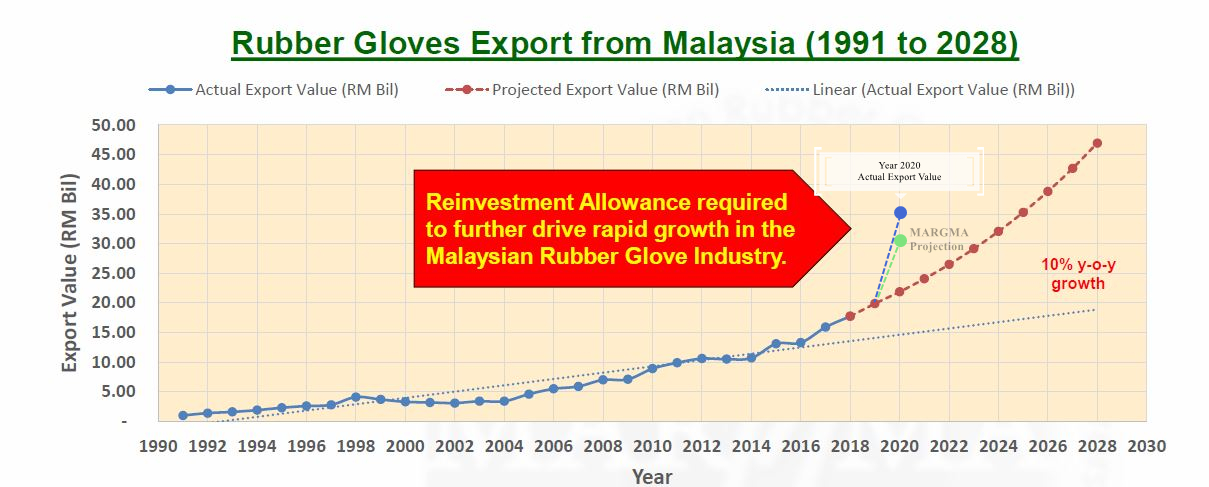
How our rubber glove doing during year 2020? Prior to year end last year, MARGMA is revising its export revenue projection for 2020 from RM21.8 billion to RM29.8 billion for year 2020 based on the performance in 1H2020.

According to my compile, Malaysia rubber glove actual export value for year 2020 has doubled to RM35.3 billion from 2019 and far exceeding MARGMA projection of RM29.8 billion by 18.3%. We knew this surge was due to higher global demand of rubber gloves, higher factory utilisation rate, additional production capacity and of course higher ASP.

But what about this year 2021, next year 2022 and post pandemic? Will it fall to pre pandemic level? Personally, I don't see this happening in future with higher awareness on hygiene, higher public healthcare expenditure and etc. Even without the pandemic, with organic growth of 10% CAGR, rubber gloves (NR & NBR) market size is expected to reach $7.5 billion by this year from 2019 ($6.2 billion).


If we look on Frost & Sullivan report, the forecasted market size of global rubber gloves (NR and NBR) market for year 2020 is USD11.6 billion. In term forecasted sales revenue, latex gloves projected at $3.2 billion and nitrile gloves has the largest market share of $8.4 billion for year 2020E.

With average exchange rate of USD1 to MYR4.2015 for year 2020, Malaysia export value was c. $8.4 billion accounted 72% of F&S forecast. However, I believe the actual market size is bigger than the forecast. From what I gathered, China export value for rubber gloves estimated at $2.1 billion. If we include our neighbour Thailand and Indonesia, I'm sure it's exceeding the forecasted $11.6 billion.

Glove

Glove Supply and the Supply-Demand Disequilibrium (Top Glove, Supermax, Hartalega, Kossan, Intco, and Others)

Author:    |    Publish date: 


The top 3 concerns expressed regarding the near- and mid-term future of the rubber glove industries can be grouped as COVID-related, demand-related, and supply-related. I have previously discussed my findings and analysis in a summarized manner in the links below:

1. COVID-related:

Timeline of the pandemic (as of beginning of January 2021)

Additional problems with the timeline, and associated risks (as of end of January 2021)

2. Demand-related:

Glove imports in the US (the main market)

Glove imports in the UK, Canada, and Japan (3 of the top 4 second-tier markets)

Post-pandemic demand drivers

3. Supply-related:

New capacities in the US

However, up to now I have not discussed in detail the worldwide supply side of the equation, as well as the supply-demand dynamics and the currently existing disequilibrium. I will attempt to do that in a concise manner below.

My Research

Over the last few weeks I have been working on a research related to the global supply of nitrile and latex gloves. I spent a substantial amount of time on the research in order to make sure that the data is as representative as possible. As with any real-life research though, albeit my best effort, available data is imperfect for a number of reasons, including the dynamically changing nature of the business, trade secrets, and different reporting standards in different jurisdictions, among a myriad of other reasons. Some general statistics related to my research:

- I managed to identify 123 manufacturers of nitrile and rubber gloves in the world.

- These include 86 Malaysian companies, 18 Chinese companies, a major Thai company, and a number of predominantly smaller players with manufacturing facilities in Thailand, Indonesia, Vietnam, India, Sri Lanka, USA, Taiwan, UAE, Algeria, Ukraine, and Turkey.

- Of these, I managed to unearth the production capacities of 72, including all of the major players.

- The highest percentage of available production capacity data is related with the listed companies, and in particular the newcomers in the glove manufacturing industry in Malaysia, of which I counted 19 companies, including 5 acquisitions of pre-existing players. Production capacity information is available for all of them.

- The second highest percentage of available data comes from companies members of the Malaysian Rubber Glove Manufacturers Association (Margma). I found information for all but 13 of these companies.

- I have strong suspicions that some of the other Malaysian companies, which are not members of Margma, have been acquired by some of the bigger players, or they have closed doors, as I did not find any up-to-date mentions of some of these companies.

- Overall, the data I have collected accounts for over 95% of the available production capacity of nitrile and latex gloves in Malaysia, according to data published by Margma last year, and I believe for over 90% of the available production capacity in the world.

Some additional notes on how the data might have been adjusted:

- The present capacity is estimated as at end-2020 for most companies. Where reports for extra capacity coming online have emerged, they have been taken into account in the present capacity figures.

- When the exact end date of additional capacity being commissioned is not known, the end of the earlier full year is used in most cases, unless discrepancies between different sources exist, in which case the end of the present full year at which the capacity is expected to be commissioned is used.

- The figures are self-reported by each of the companies, directly or indirectly. Thus, some of the figures may be inflated.

- At all times, the self-reported figures are taken to mean maximum production capacity at 100% utlization rate of the manufacturing facilities.

- The final figures are adjusted to 80% utilization rate. The industry average across the major players is 75%-80%, and it is lower for the smaller players.

- The full set of data is available upon request to anyone interested.

General Findings
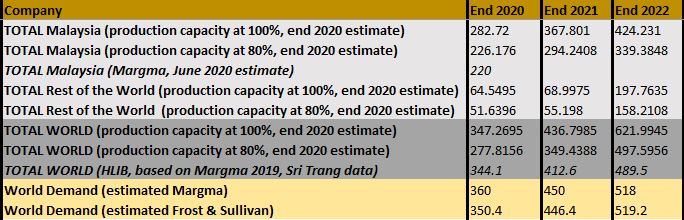
In my glove supply findings, I provide reference estimates from a 2020 Margma report (source), and from a Hong Leong Investment Bank (HLIB) report which is based on 2019 Margma estimates and data from Sri Trang (source, a downloadable file).

Demand data is based on 2021 Margma data cited by Top Glove (source), and on a 2020 Frost & Sullivan report (source).

My production capacity estimate for Malaysia at 80% utilization rate is above the 2020 Margma figure. My estimate for the world is below HLIB's estimate for 2020 and 2021, but above their estimate for 2022. This may be due to different adjustments or assumptions that might have been made in their analysis. For instance, the assumption for 2020 and 2021 might be at higher utilization rates than the normal utilization rates (closer to 100% for instance).

Additionally, I have included Margma's and Frost & Sullivan's natural growth estimates only. I have not included estimates on the excess demand for 2020 and 2021. According to Ansell (source, a downloadable file) and according to data by AmerCareRoyal cited by Forbes (source) the demand for gloves in 2020 was actually 585 billion gloves (from 350.4 and 360 billion projected by Margma and Frost & Sullivan).

As can be seen above, with all of these assumptions in mind, the projection is that by the end of 2022 there will be a shortage of between 20 billion and 30 billion nitrile and latex gloves.

Supply-Side Considerations

One of the most frequently expressed concerns on the supply side is that production overcapacity will lead to oversupply and a sudden sharp drop of average selling prices across the board. As can be seen from the illustration above, that is unlikely to happen. However, let's look more closely at where the main additional supply will come from.

The main extra production will come from 3 groups of sources - Malaysian companies which are members of Margma, Malaysian newcomers and companies acquiring existing glove manufacturers, and major players in other countries. A major player is defined as a company whose production capacity at present is at least 5 billion pieces of nitrile and/or latex gloves. Where a company's main production facilities are in Malaysia, the company is listed as a "Malaysian" company for the purposes of this research.

 

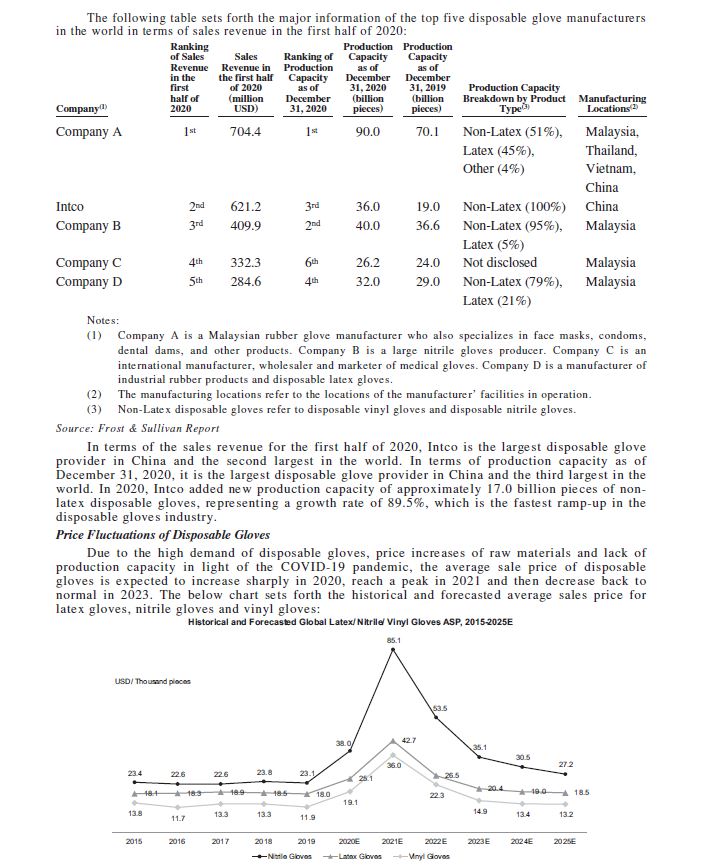
As can be seen, most extra capacity will come from non-Malaysian players. Of these, by far the biggest contributor is the Chinese company Intco Medical. Intco plans to expand its production capacity to a total of 120 billion gloves over the next 15 months according to company's latest announcement (source). The current capacity of the company (as of last week) is 45 billion gloves. However, this capacity includes 24 billion vinyl gloves, and 21 billion nitrile gloves. For the purposes of this study we do not look at the vinyl glove market. In my assumption for the extra capacity, I have excluded the current capacity of vinyl gloves and I have assumed that all of the extra capacity will only go towards nitrile glove production. In other words the assumption is that by 2022 Intco will be able to produce 96 billion nitrile gloves per year. The second biggest non-Malaysian player - Sri Trang (Thailand), plans to increase its current production capacity of 32.619 billion pieces per year to 49.133 billion pieces per year by 2022 (source).

However, the second and third largest capacity expansions will be done by Malaysian companies. Top Glove reported 84 billion pieces production capacity (excluding vinyl gloves) and the company plans to increase that to 121.1 billion pieces by 2022 (source). Supermax plans to increase its production capacity from 26.175 billion pieces at present to 48.425 billion pieces by 2022 (source). As I have discussed before, this extra capacity excludes any capacity that will be commissioned overseas (see here).

There are so far 5 known acquisitions by non-industry players of Malaysian rubber glove companies: 

- Diversified Gateway Solutions acquiring Duramitt (source)

- Salcon acquiring JR Engineering (sourcesource)

- Vizione Holdings acquiring SSN Medical (sourcesource)

- Inix Technologies acquiring L&S Gloves (source)

- Eonmetall Group acquiring Lienteh Technology (source)

Of course the acquired companies already have a certain amount of production capacity available. However, I have elected to give the figure for 2020 as 0 in this case in order to illustrate better this perceived additional capacity from newcomers to the industry. As can be seen, the maximum capacity from all 14 newcomers and 5 "acquirers" is estimated to be 51.311 billion pieces by 2022. This figure is significantly smaller than the figure for extra capacity coming from Intco alone, and it is slightly bigger than the extra capacity coming from Top Glove alone. Additionally, the 15 newcomers are expected to face difficulties such as raw material constraints, labor force shortages, and construction and production line installation related problems (source)

In total, out of the total projected extra capacity of 274.7 billion pieces per annum, 132.4 billion (48%) will come from major players outside of Malaysia, 88.42 billion (32%) will come from established players in Malaysia, and 51.3 billion (18.5%) will come from newcomers to the industry in Malaysia. In terms of individual players, 79.5 billion extra pieces per annum (or 29% of the entire extra capacity) will come from Intco, and 37.1 billion pieces (or 13.5% of the entire extra capacity) will come from Top Glove.

Conclusion

As a growth industry for over a decade now, the glove manufacturing industry is demand-driven. Any self-reported plans on additional production capacity will inevitably take the corresponding demand into account. Thus, it is possible that players with aggressive expansion plans but at the same time with major exposure to certain individual markets (Intco, exporting 50+% of its production to the US for instance) may change their strategy if the situation requires it. Overall, supply will be running behind demand at least in the next 2 years (according to Hartalega - for the next 3 years; source) even with the aggressive expansion of Intco, Top Glove, other major players, and the inevitable newcomers.