显示标签为“Coffee Roaster Machine”的博文。显示所有博文

2021年7月6日星期二

Coffee Roaster Machine


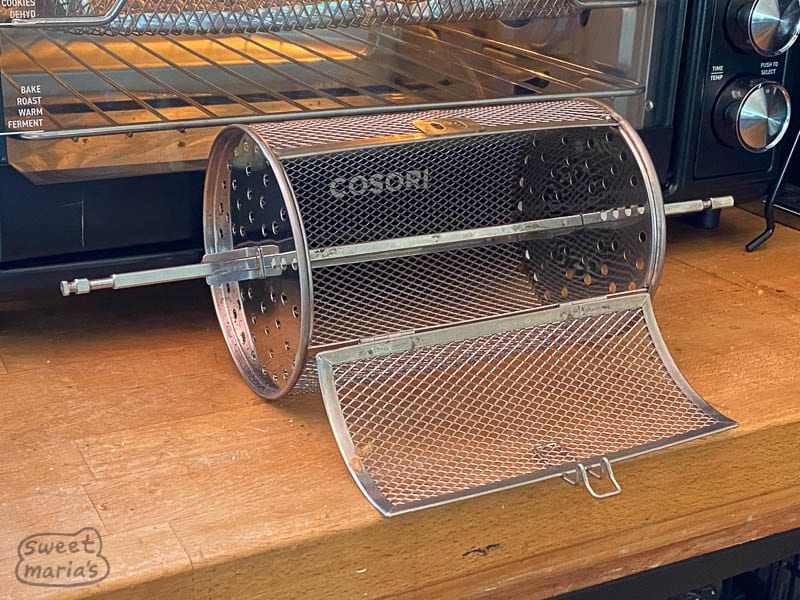
Roasting Coffee in a Rotisserie Drum in a Toaster Oven Air Fryer

Some Air Fryer / Convection Toaster Oven models come with a Rotisserie spit, and it’s possible to roast coffee in them. Here’s why you shouldn’t do it!

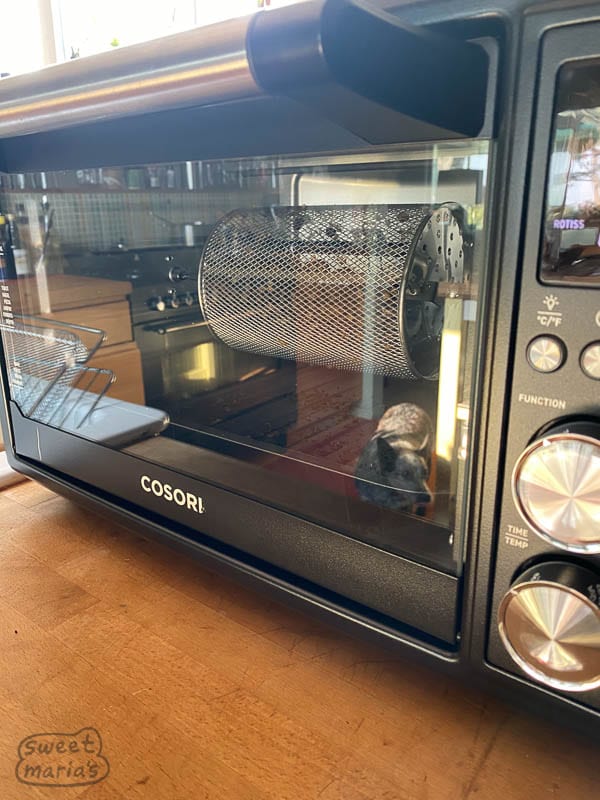
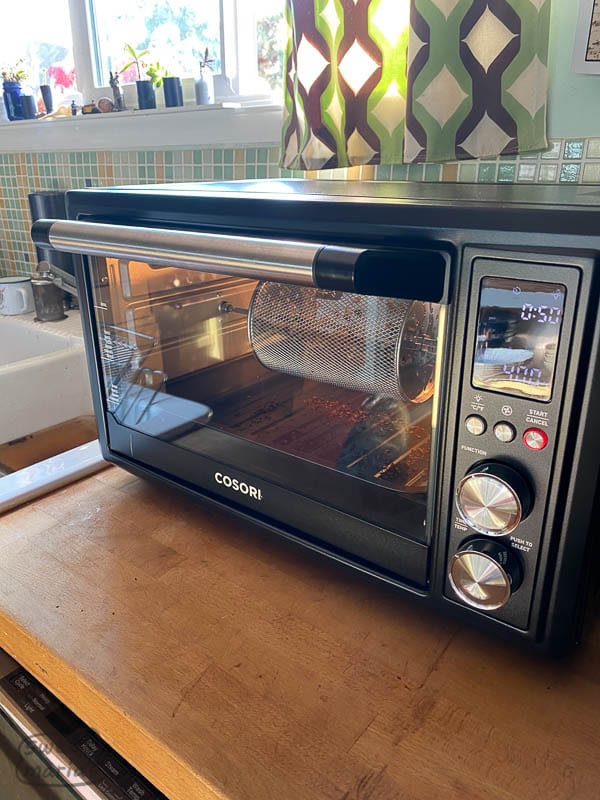
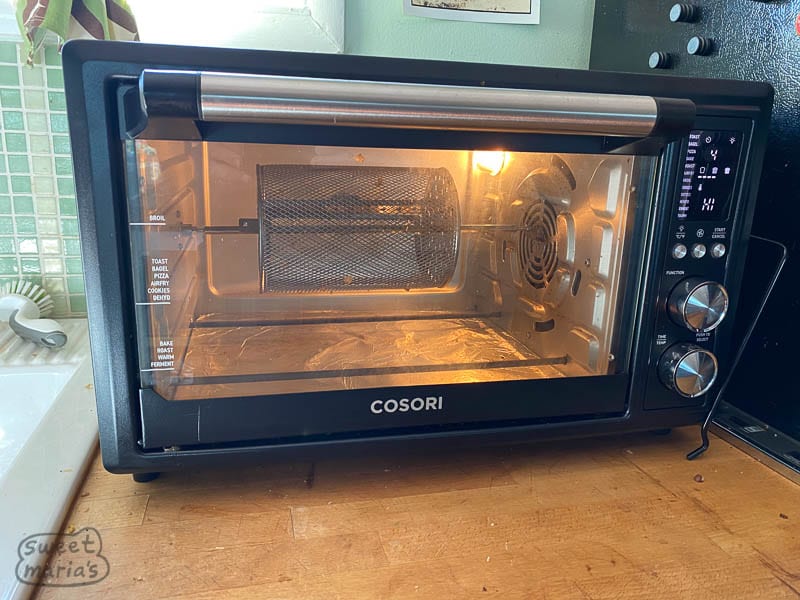
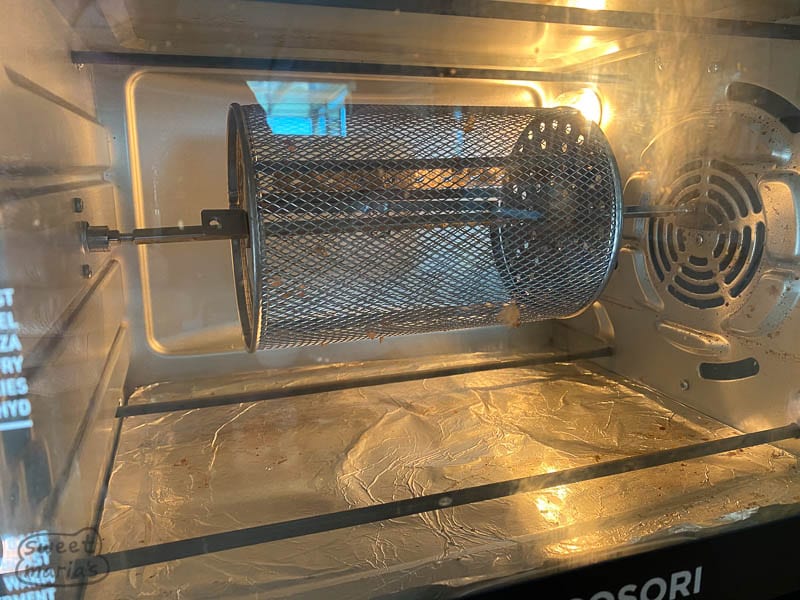
I bought this particular model of air fryer because it had a rotisserie, and because the spit rod that came with it fit and inexpensive metal mesh wire drum sold online. The air fryer toaster oven I have been using is this: Cosori Brand, 30L, 31.7 Quart, CS130AO Model, $199 online. The drum is sold under various names, mine was called Falytemow (!?!) Stainless Steel 12 x 18 cm Rotisserie Drum, $19.99. The plus side of this pairing is the drum does fit on the Cosori roasting spit rod including with the oven!

So let me back up … I am definitely not saying you shouldn’t do this! Roasting coffee in a rotisserie drum does indeed turn green coffee brown! It’s just not as easy as it seems…

I just want to share my experience, which was a surprise to me, a person with 30+ years of coffee roasting experience. I was really shocked how difficult this was to judge the roast, how slow the roast process was, and how the coffee turned out. At the same time I was more surprised (pleasantly) that roasting on a flat sheet using high convective air flow on the “bake” setting, or on the air fry setting, has great potential!

The drum roast was very even I admit. The coffee looked nice.Why is it so slow? Partly this has to do with the limited heat range I mention below. But you can roast at 400f max temperature in other modes. Why? Because the coffee is not massed together in the limited drum space; it is spread out thin on a sheet.

A solid drum commercial roaster versus a rotisserie: Two different things!

400f is not hot enough as an environmental temperature for drum roasting. Commercial drum roasters are capable of much higher ET. And most important, in a commercial drum roaster you aren’t heating a huge space around a perforated mesh drum; you are transferring heated air directly through a solid steel or cast iron drum.

The heat transfer is completely different. Even though both are “drum roasting.” they couldn’t be more different. (This goes for roasting on an outdoor barbeque rotisserie as well but that’s a different egg to crack). That’s not saying a mesh drum or perforated drum rotisserie can’t be used to good effect. It does after all turn the coffee around … but even that is not at all like the design of the commercial drum roaster. Perhaps some illsutrations help:

Coffee roaster illustration from the web labeled as Probat Air Flow. I don't think that is right - it appears to be a recirculating Jabez Burns Thermalo roaster type
An image from the web, which was labeled as Probat Air Flow. I don’t think that is right – it appears to be a recirculating Jabez Burns Thermalo roaster type to me. Needless to say, it documents air flow channeled through a solid drum, which has a complex system of paddles, not much like a perforated drum / rotisserie operating in a large hot box at all.
Sketchy sketch: To illustrate this I attempted  to draw how a drum coffee roaster of the commercial Probat variety focuses air flow through a solid drum. But a rotisserie type roaster with an "open mesh drum" has no "focused" air flow.  It's a turning cylinder in an environment with general air blowing around in it. One is like a wind tunnel (the solid drum roaster). The other is like a windy place.
Sketchy sketch: To illustrate this I attempted to draw how a drum coffee roaster of the commercial Probat variety focuses air flow through a solid drum. But a rotisserie type roaster with an “open mesh drum” has no “focused” air flow. It’s a turning cylinder in an environment with general air blowing around in it. One is like a wind tunnel (the solid drum roaster). The other is like a windy place. -Thompson

Some of my issues might be with the model I bought, the Cosori, but I did seek out the highest wattage model with a rotisserie spit I could find, so perhaps these are issues with many models with and with drums like this.

The biggest issue: You really can’t see the coffee roast level at all. I end up feeling like I’m lost as to where the coffee is at in the roast process … and I’ve been doing this quite a while on many types of roasters! To stop the drum, check the coffee by opening the door (burn alert), reinstalling it, and starting up the process again is difficult and impractical.

The roast results were indeed even, but the installation and removal of the drum spit made it too hard. Pinpointing the stopping point in the roast, which matters by a measurement of seconds in coffee roasting, was guesswork to some degree. Opening the hot drum to get the coffee out to cool was painful, since I don’t have those neat high temperature gloves.

It’s not impossible of course. Here’s my tips: Set the fan speed to the highest possible. Since my oven restricts rotisserie high temp to 400f, it’s important to preheat the oven, then put the loaded drum in to start roasting. Listen carefully as coffee sounds can be confused with first crack, especially since first crack is faint sounding in a long roast process. Push the heat as much as possible to get the roast done asap. My fastest, despite all my efforts was 25 minutes, which is slow and results in a somewhat flatter roast taste in the cup. You can get some improved visibility of the coffee in the drum by shining a strong led light through the front glass of the oven, upward toward the drum.

While I found the rotisserie setting disappointing, I became curious of the potential of the air fry settings and similar ones available by using “bake” function but manually setting the fan on the highest level possible. And I had some good results! (Please read the main article about Air Fryer Coffee Roasting / Convection Oven Coffee Roasting for details).

Related: Toaster Oven Coffee Roasting Method (Air Fryer – Convection Toaster Oven)

Coffee Roaster Machine


Flame height and location in drum roasters

Post Reply 
9Sbeans

#1Post by 9Sbeans » 

The complete-combustion blue flame of air-propane mix is very hot, up to 1970*C (3580*F).
http://www.elgas.com.au/blog/1585-why-d ... ne-methane
Don't let the flame directly touch the perforated drum wall.

Here are some ancient links of related topic.
Combustion Gases in Coffee Roasting
Exploring the Huky 500 Coffee Roaster, Part II

And my quick sketch of (A) worst case scenario and (B) ideal cold air inlet. I'll elaborate my thoughts when I get more time.

Quotable Quote: He doesn't remember what a good shot tastes like and isn't complaining about anything but the way the shot looks!

Moderator note: This thread is worth its own discussion, so I've split it off from its parent thread:

Constant high airflow doesn't seem to work with my roaster
CafelatStore: home of Cafelat products online
Sponsored by CafelatStore - home of Cafelat products online 
User avatar
drgary
Team HB

#2Post by drgary » 

Patrick, what about my experience that I've gotten many good roasts with the flame touching the drum as shown, with enough airflow to allow oxygen for the flame, relatively high charge so there are a lot of beans to absorb heat, and higher drum speed, so the beans are tumbling well? There is minimal and usually no scorching and there's never tipping. Added: Generally I'm following your suggestion so that higher heat may be applied with large loads during part of the drying stage only.

Also your sketch differs from my roasting chamber, where there's much more room between the back end of the drum and the rear firewall.

Here are photos of the flame in my drum from an earlier post. The first photo is with the flame set at 2.5 kPa.

Quotable Quote: Chasing extraction yield is a great and worthwhile effort - and will probably teach you a lot. Just be careful of the subjective assessments gleaned from objective measurements.

This next photo shows the flame set at 3.7 kPa.

Quotable Quote: It's funny, I think I've spent more time reading and thinking about this [espresso equipment purchase] decision than with my last car.
Gary
LMWDP#308

What I WOULD do for a good cup of coffee!
9Sbeans (original poster)

#3Post by 9Sbeans (original poster) » 

I listed it as an example of the worst case scenario, and it doesn't necessarily apply to a particular model of any machine. However, increasing airflow in this case will result in the increased temperature difference between the hot and cold regions. The burners maintain the same even BTUs, but the high velocity airflow region has lower temperature comparing to the slow airflow region, due to more air is been heated up by the same BTU.

Quotable Quote: Sage reminders like yours are welcome, especially when they salvage a discussion that's entered into the Netherworld obsession zone between the improbable and the impossible.

Above is a picture of mini-500 with perforated drum I found on internet. (It could be only of this particular machine at the high flame setting.) There is a blue flame from the burner at the right side touching the drum. The person who takes the picture describes in his blogger that he prefers his bigger production roaster, a Fuji Royal 3kg which is also a perforated drum roaster, because the roaster produces more even roast. Note the burner in the Fuji Royal (picture below) is far away from the drum.

Quotable Quote: What I love about espresso is that you can 'taste the talent'!
9Sbeans (original poster)

#4Post by 9Sbeans (original poster) » 

It could be more complicated when charging full load or half load. When charging at lower % capacity (the black arrow, 10 seconds after charge), the beans may localize at the exit (black oval). When charging at full load (the blue arrow, 10 seconds after charge), the beans may be more evenly distributed in the drum (blue oval). It is related to the vane design.

Quotable Quote: I do a lot of things that aren't really worth it because I think my cost-benefit analytical skills are broken.
9Sbeans (original poster)

#5Post by 9Sbeans (original poster) » 

Not exactly the flame height. It's the non-linear feature of the perforated drum roaster. :)

In a solid drum the hot air has relatively more time & space to pre-mix, and the subsequent more-or-less laminar-flow through the drum. It has very broad linearly adjustable airflow and heat intensity range.

In a perforated drum the response to the variable airflow is non-linear. Assuming in the diagram of the first post, the drum is rotating clockwise, the bean pile would be accumulated at the hotter air region. Or in the Fuji Royal case the cold air inlet is feeding from the bottom of the burner and has more pre-mix space. It may increase the linear component.

Not good or bad, just its feature. Find the sweet spot for operator-adjustable parameters and stay within the boundary of the design of the machine for optimum result.
User avatar
drgary
Team HB

#6Post by drgary » 

9Sbeans wrote:Find the sweet spot for operator-adjustable parameters and stay within the boundary of the design of the machine for optimum result.
I'm totally with you on this. I think the discussion you've started here is very useful for helping people understand how to find the sweet spot. The photo you posted of the Mini 500 perforated drum roaster with uneven heat is an instance where that's obviously not the optimum setting. Yet Yang Chia makes a fine roaster, so what are its capabilities if used within its sweet spot? And how would you tell? I would think observing the interaction of flame and air, trying different profiles and cupping -- just like I tried high air flow in my roaster and found a really good way to mummify coffee.
Gary
LMWDP#308

What I WOULD do for a good cup of coffee!
walt_in_hawaii

#7Post by walt_in_hawaii » 

Sorry, can someone post a pic of the back wall of any of these solid drum roasters so I have an idea of how much ventilation is coming through the back? Difficult to pin down the airflow... my experience is with only perf drum roasters of ~half pound capacity, and fluid bed roasters. New to solid drums.

aloha,
walt
Weber Workshops: tools for building better coffee
Sponsored by Weber Workshops - tools for building better coffee 
User avatar
FotonDrv

#8Post by FotonDrv » 

Question, whether it is a perforated drum or a solid drum, wouldn'y the flame height have a direct relationship to heat change in the Air and the Drum temps?

I have my roaster working on Natural Gas after a month on Propane and when I switched to Natural Gas I was getting very hot temps and the roast was pretty uncontrollable for me (Iam a newbie to a gas roaster). I noticed that I could turn the gas valve so low using Natural Gas that Propane would have died out much sooner. I had to lower the burners to almost their lowest setting/placement.

I run the roaster mostly in the .5kPa range, maybe going to .7 or down to .4. Just to idle the roaster I can run it at .15kPa. Propane would quit at about .3kPa.

Lowest setting.
Quotable Quote: Badly paid job full of annoying people customers. Are you really sure you want to do it?

I have 5 burners in a row with this solid drum, but I do know that Bella Taiwan makes a perforated drum roaster as well but I am not sure the sizes of them.
Quotable Quote: Chasing extraction yield is a great and worthwhile effort - and will probably teach you a lot. Just be careful of the subjective assessments gleaned from objective measurements.

Front of drum is on the left in the lower photo. I ended up lowering the burner bar further using Natural Gas, but if I was using Propane I would raise it back up closer to the drum. I like this little roaster's adjust-ability with air, temp settings and drum speed.
That Light at the End of the Tunnel is actually a train
User avatar
FotonDrv

#9Post by FotonDrv » 

walt_in_hawaii wrote:Sorry, can someone post a pic of the back wall of any of these solid drum roasters so I have an idea of how much ventilation is coming through the back? Difficult to pin down the airflow... my experience is with only perf drum roasters of ~half pound capacity, and fluid bed roasters. New to solid drums.

aloha,
walt
Quotable Quote: It could be worse, at least we're not all into boats.
That Light at the End of the Tunnel is actually a train
walt_in_hawaii

#10Post by walt_in_hawaii » 

Thanks FD!